Facultory carries three things end to end: the public front door
students and colleagues reach you through, the research pipeline
from opportunity to award, and the academic record that turns both into a CV,
a biosketch, and your annual report.
Not three products — three chains through one desk, each handing off to the next. Anything you enter once
is available to all of them.
The faculty front door
Everything students and colleagues need from you arrives through one public page — and lands in one queue only you can read.
Your public page One address on your own handle carries office-hours booking, letter requests, lab / TA / RA intake, senior-design teams, and your seminars. Students and colleagues never make an account to use it.
They ask, on your terms Each surface carries its own guardrails — typed-only answers, email verification, meeting types, buffers, slot caps, and the windows you set. Your booking link is yours to hand out: department and university pages never post it, and your own profile lists it only if you say so. Every booking goes out as a standard calendar invite that Outlook, Google, and Apple all read, and a reschedule updates the same entry.
One private inbox Bookings, RSVPs, letter requests, senior-design teams, prospective-student notes, and Faculty Match interest all land in a single Requests queue. There is no chair, department, or platform read path into it — student records stay yours, by construction.
Office hours & booking · Letters of recommendation · Prospective students · Senior design · Seminars & events · Faculty Match
The research pipeline
One funding opportunity, carried to the award and the publications it produces — without retyping it at any hop.
Opportunity Federal and foundation opportunities scraped weekly and enriched with deadlines, award ranges, and topic tags, ranked against the work you actually do.
Pursuit Promote one into a pursuit: a kanban stage, internal deadlines, a document checklist, a personnel roster, and Kit ideation threads that become versioned drafts.
Proposal artifacts The paperwork assembles from the record you already keep — NSF COA / conflicts, biosketch, current-and-pending, broadening-participation plan — instead of being rebuilt for each submission.
Award becomes a project An awarded pursuit is promoted into a project once and only once, carrying its personnel, deadlines, and documents across with it.
Back into the record The project’s publications, effort, and travel flow back into the publication tracker, your CV, and the annual report — which is where the third story starts.
Log the year once. The documents your department asks for assemble from it — deterministically, with no AI in the loop.
It accrues while you work Publications sync from OpenAlex and ORCID, cross-checked against Crossref, Semantic Scholar, Google Scholar, and DBLP. Reviews, panels, and editorial roles land in the service tracker; advisees, milestones, and courses in theirs.
Documents render from it CV, NSF/NIH biosketch, and current-and-pending come off one profile. The COA spreadsheet builds its collaborators table from your co-authorship graph and its advisees table from your own roster.
The annual report writes itself The FAR pulls publications, pursuits, service, advising, and teaching for a date window into one report. It is assembled deterministically — no model is called — and recommendation letters appear only as counts by type, never by student.
Take the scheduling desk on its own (The Datebook), or the full desk — every tool in the suite — and then
choose how much of Kit, the built-in AI, you want: none at all, your own AI, or ours. Pay for the academic year and
summer is free — nine months’ price for twelve months’ access — and on any Full Desk plan the academic
year unlocks the academic-leadership tools.
Loading plans…
Everything on the desk
The full inventory
Every tool below ships with every Full Desk plan — The Datebook keeps just the
scheduling desk — and Kit drafts inside all of them.
It is a long list on purpose; the three stories above are the short answer.
Explore all tools — nine suite areas, in full
Research & funding
Weekly-scraped grant opportunities, a Kit-powered ideation workspace, and a pipeline from idea to submission.
Publications & CV
Auto-synced publications with citation tracking, plus one-click CV and NSF biosketch generation.
Teaching & students
Syllabi, rubrics with AI feedback, office-hours booking, and a full course scheduler.
Service & mentoring
Advisee tracking, a recommendation-letter portal, and a senior-design match directory.
Outreach & events
Public event pages, RSVPs, and seminar scheduling — all on your own handle.
Records & reporting
Annual reports, effort and travel logs, and a tidy record of everything you do.
Email, sent as you
Confirmations, decisions, reminders, and digests go out from your own address — editable templates, merge fields, and an outbox that keeps the record.
Calendar invites & meetings
Every booking lands as a standard calendar invite that Outlook, Google, and Apple all read — office hours, time blocks, and group meeting requests that put a whole team on one invite.
Your public byline
Public pages on your handle: office-hours booking, letter requests, senior-design and lab intake, seminars, and events.
Kit, the built-in AI, drafts inside every tool — and you pick the rail: the platform’s credits, your own key
(Anthropic, OpenAI, Gemini, or xAI), a department key, or copy-and-paste into a web chatbot you already have. Prefer none of it? The Datebook and
Full Desk — Manual switch Kit off entirely.
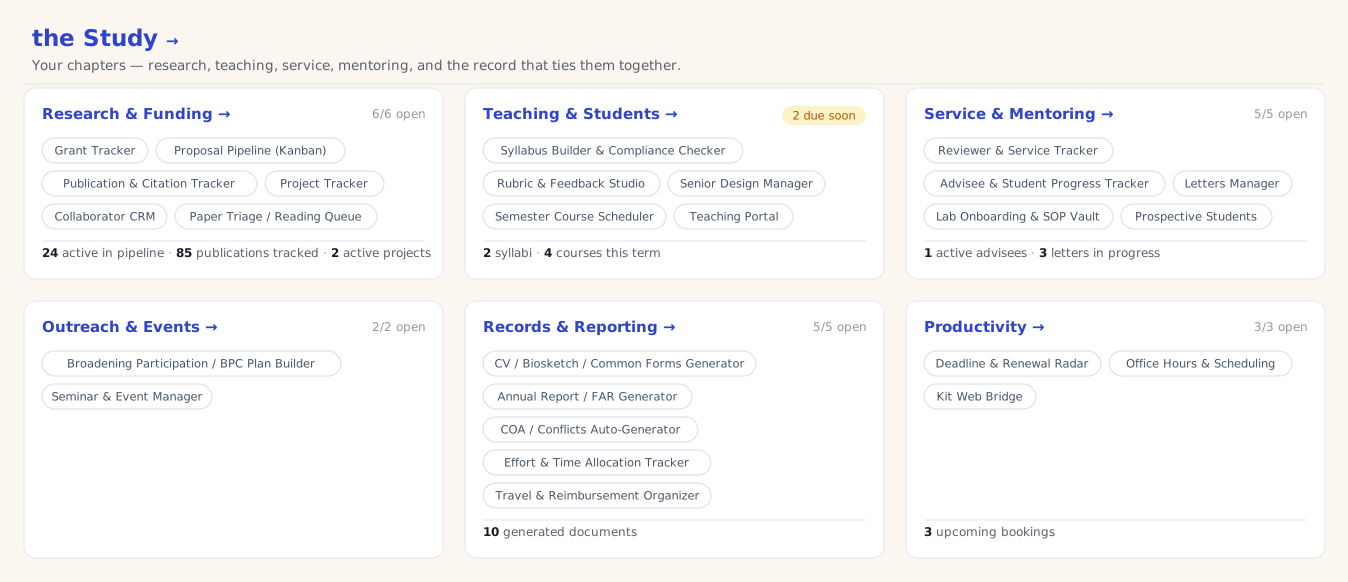
Research & funding
Grant Tracker — weekly-scraped funding opportunities, enriched with deadlines, award ranges, and topic tags
Ideation threads with Kit on every pursuit, promotable into versioned drafts
Proposal pipeline — kanban from idea to submission, with internal deadlines, document checklists, and personnel rosters
Project tracker — awarded, gift, or unfunded projects carrying work products through to publication
COA / conflicts generator — the NSF Collaborators & Other Affiliations spreadsheet, built from your record
Collaborator CRM auto-seeded from your co-authorship graph
Paper triage — a preprint feed ranked against your own work
Publications & the record
Publication & citation tracker synced from OpenAlex and ORCID, cross-checked against Crossref, Semantic Scholar, Google Scholar, and DBLP
Citation counts and h-index tracked per source, never blended
CV, NSF/NIH biosketch, and current-and-pending rendered from one profile
Annual report / FAR assembled from the year you actually had
Reviewer & service tracker for reviews, panels, editorial roles, and committees
Effort tracker with over-commitment warnings; travel organizer with receipt extraction
Teaching
Syllabus builder & compliance checker with a reusable component library
Rubric & feedback studio — AI feedback anchored to rubric cells, human-in-the-loop
Teaching portal — each term’s courses, meetings, and materials in one hub
Semester course scheduler — demand projection, auto-drafted sections, full conflict reports, and faculty availability surveys
Letters of recommendation manager with a public request portal and grounded first drafts
Senior design manager — team intake, slot caps, and presentation booking
Prospective-student intake with typed-only answers and authenticity signals
Email, calendar & meetings
Email sent as you — through the platform or your own Resend, SendGrid, Mailgun, or Postmark account, with editable templates and merge fields
Booking confirmations, decision emails, 48-hour reminders, and recurring digests — every send recorded in an outbox
Standard calendar invites (Outlook, Google, Apple) on every booking and time block; a reschedule or cancel updates the same entry
Group meeting requests — a senior-design team requests a slot and books its presentation with everyone on one invite
Office-hours booking on your public page, with meeting types, buffers, and Zoom / Teams / Webex / Meet locations
Connect your Outlook or Google calendar as a busy overlay so offered slots respect the meetings you already have
Outreach & events
Seminar & event manager — speaker pipeline, public event pages, and RSVPs on your handle
Share Out — per-platform post drafts in your own voice for LinkedIn, X, Bluesky, and Mastodon
A digest that watches your new publications, projects, and events for things worth sharing
BPC plan builder — broadening-participation plans and an activity ledger for NSF
Academic leadership
Department dashboard — enrollment, credit-hour production, and workload distribution at a glance
Faculty workload planner — per-term staffing scenarios balanced against targets
Annual review hub — the whole cycle from self-report to released evaluation
Faculty Match — a per-unit directory for committees, advisors, and experts, with bulk roster import
Department seat blocks with volume discounts and invoicing
Kit, the built-in AI
Drafts across every tool — narratives, letters, feedback, plans, and posts
Three rails: platform credits, your own Anthropic key, or copy-and-paste with any web chatbot
Claude Web Bridge (limited preview — not yet available on any plan) — connect claude.ai to Facultory as a custom connector, or work by prompt packet
The platform
Deadline & renewal radar — one prioritized timeline across every tool
Lab vault — a searchable knowledge base of your lab’s SOPs and onboarding
One login, role-based permissions, and self-serve tool selection
FERPA-conscious by design — student records stay private to you
Sync your content to your own GitHub repo; connected keys stored encrypted
Request-a-tool — departments can commission new tools into the suite
Departments
Bring your whole department
Facultory loads a department’s public roster at no cost — claimable faculty profiles, booking pages,
and a free public directory with smart search. No obligation for anyone who never claims theirs. Already listed?
Find your page on the front door →